Social Work and the Far Right in European Democracies (SoFRiED)
De-professionalisation from the right. A comparative study in Germany, Austria, and Hungary
How can social work respond to changes in welfare state principles, neoliberal social policies, increasing economisation and precarisation, and shortages of skilled professionals, which are giving rise to tendencies of de-professionalisation? These tendencies manifest themselves in the weakening of structures, competencies and autonomy within the profession.
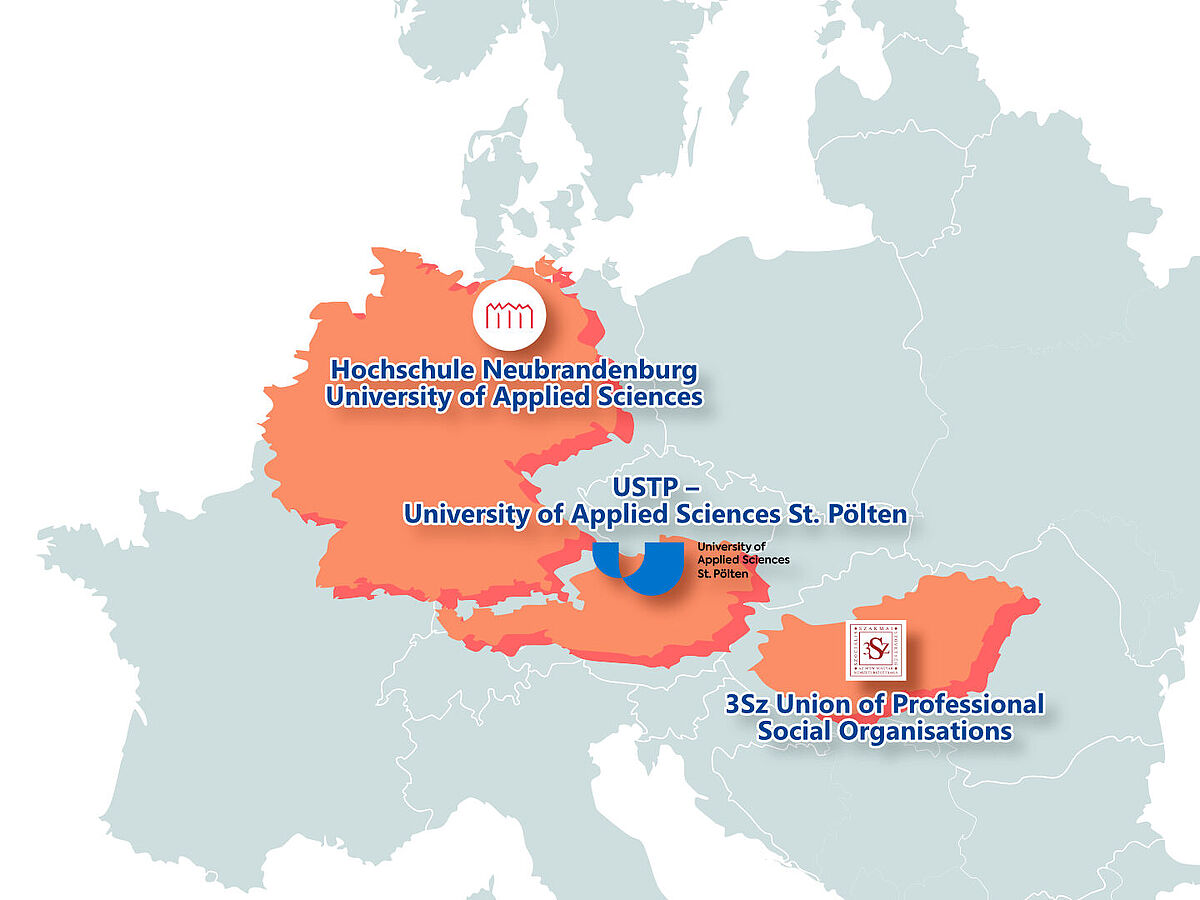
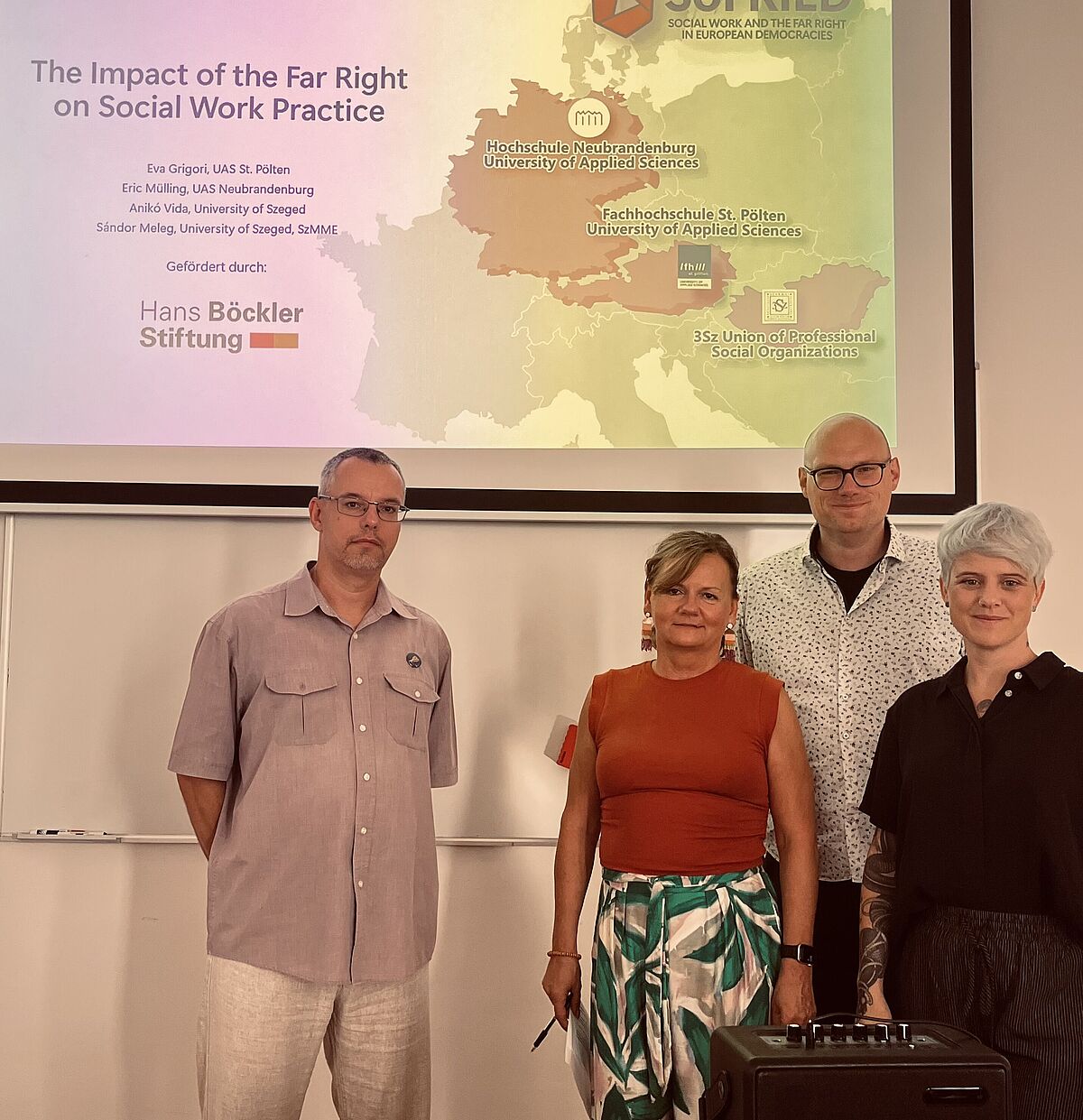
Furthermore, the Europe-wide and global rise of right-wing authoritarian and anti-democratic thinking and practices is increasingly undermining the professionalism of social work. This is despite there being internationally coordinated theoretical and ethical standards that oppose anti-human and inequality-reinforcing positions. The SoFRiED mixed-methods study investigates and compares the influence of the far right on social work in the EU member states of Germany, Austria and Hungary, taking into account the respective welfare state contexts. Building on two systematic, federal state-specific studies from Germany — North Rhine-Westphalia: Gille/Jagusch (2018) and Mecklenburg-Western Pomerania: Gille, Krüger & Wéber (2022) — the study analyses the effects of far-right actors, networks, discourses and policies on social work. The project comprises three country-specific sub-studies, each consisting of three methodological components: a quantitative online survey; problem-centred individual interviews with social work professionals; and an analysis of parliamentary documents. The text-based data generated through these three components are supplemented and contextualised by a media analysis and evaluated through explicative, structured qualitative content analysis.
The study’s research objectives are based on the following research questions:
- In what ways are far-right influences evident in social work in the EU member states of Germany, Austria and Hungary?
- How do these influences affect the welfare state architecture and social policy measures that constitute the framework for social work at a national level?
- To what extent are processes of de-professionalisation driven by the far right and restrictions on democratic participation opportunities for practitioners evident in organisational contexts?
- To what extent do professional practitioners recognise and identify far-right influences in their everyday professional practice?
- Which professional approaches, counter-strategies and institutionalised responses are articulated within the profession (professional associations, interest groups and civil society), as well as in social work education and practice, when dealing with far-right influences?
Project duration: 02/2025 – 01/2027
Funded by: Hans Böckler Foundation